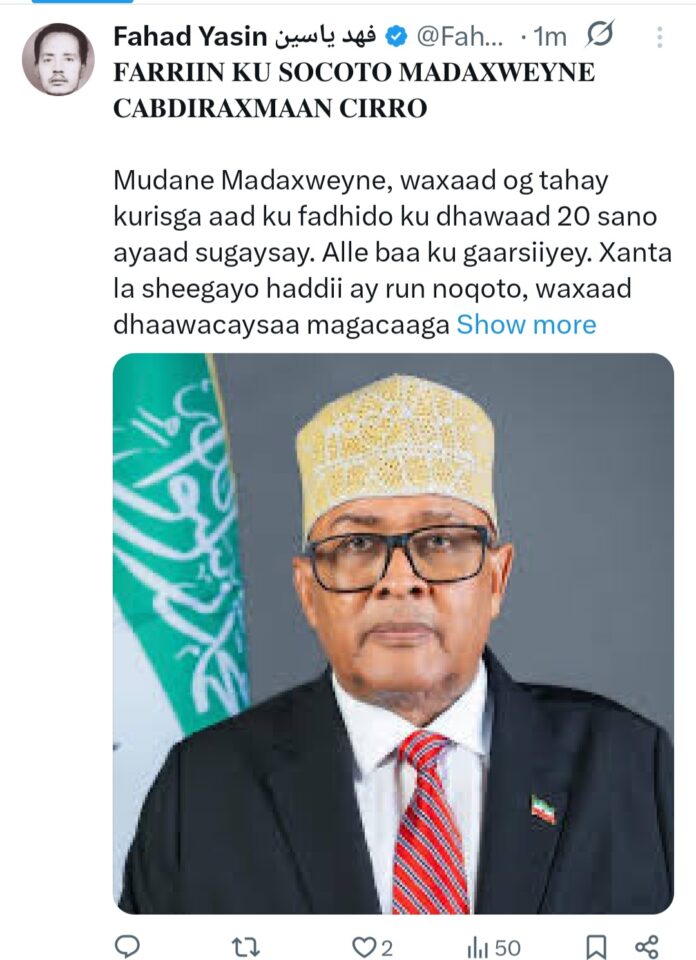
Fahad Yasin Cautions President Cirro Over ‘Irreversible’ Political Move
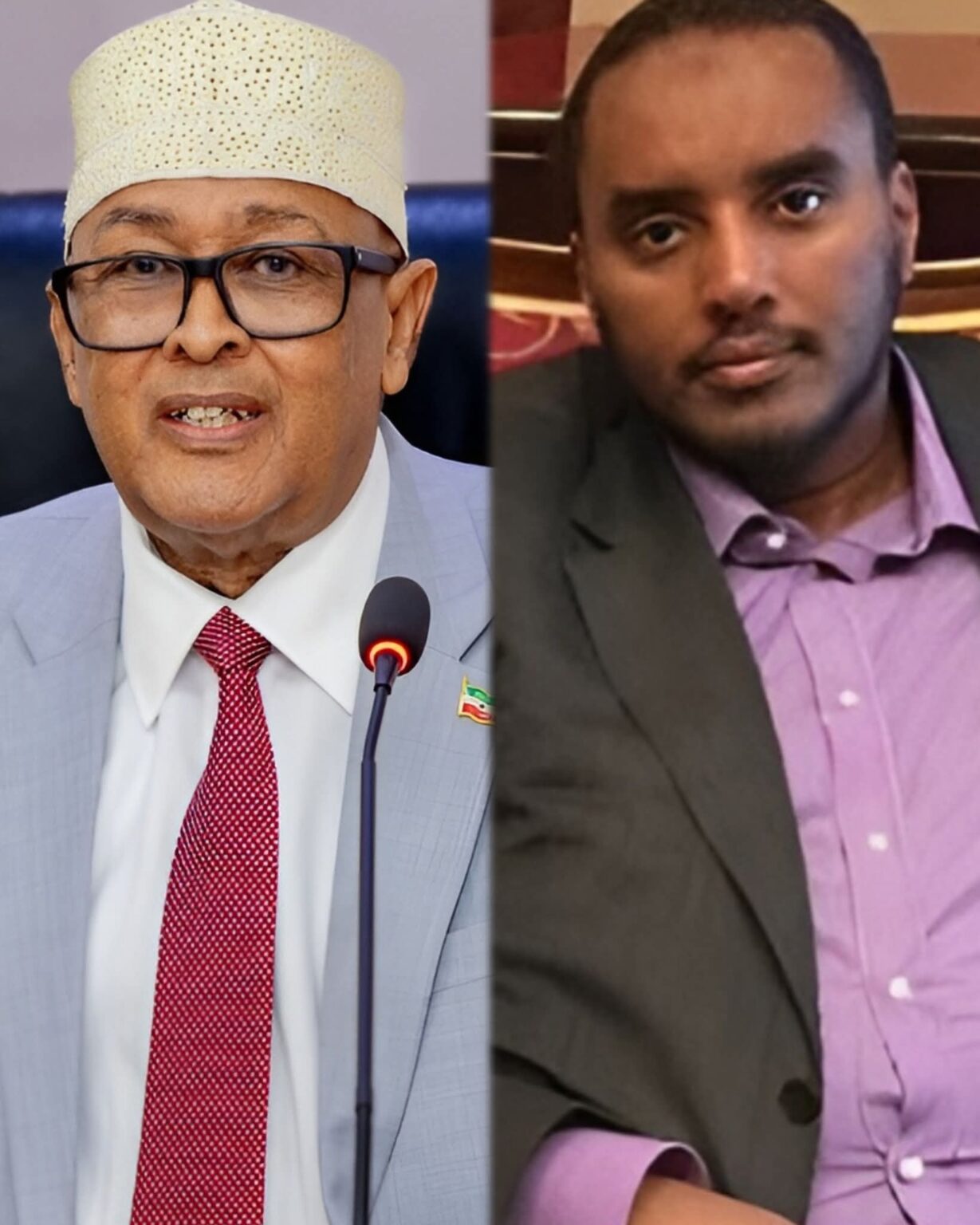
Former NISA chief Fahad Yasin has publicly warned Somaliland President Abdirahman ‘Cirro’ against an alleged political move he says could irreversibly damage Cirro’s legacy and Somaliland’s long-term standing.
Former Director of Somalia’s National Intelligence and Security Agency (NISA), Fahad Yasin Haji Dahir, has issued a strongly worded public warning to Somaliland President Abdirahman Mohamed Abdillahi (Cirro), cautioning him against what he described as a potentially irreversible political decision that could damage both his personal legacy and Somaliland’s long-term standing.
In a statement published on his official social media platforms, Yasin addressed President Cirro directly, reminding him of the decades he spent pursuing political leadership before finally assuming office.
“Mr. President, you waited nearly 20 years for the seat you now hold. God granted you this position,” Yasin wrote.
He warned that if ongoing rumors about an imminent political move are accurate, the President risks undermining his reputation and rewriting his historical record in a negative light—without any assurance that such actions would achieve their intended political goals.
Yasin framed his warning within Somaliland’s political history, noting that former leaders—including Abdirahman Ahmed Ali Tuur, the region’s first president, and Muse Bihi Abdi—avoided taking similar steps despite facing comparable political pressures.
“From President Abdirahman Tuur to President Muse Bihi, none dared to cross this line,” he stated, urging President Cirro not to be the first to do so.
He further argued that even the controversial maritime agreement signed between Muse Bihi and Ethiopia would pale in comparison to the consequences of the alleged new move, suggesting it could quickly fade into obscurity if President Cirro proceeds.
Addressing Somaliland’s long-standing quest for international recognition, Yasin cautioned against pursuing legitimacy through actions that could invite global criticism or moral backlash.
“If you seek recognition, do not drag your people into humiliation or stain your own name in the process,” he wrote.
He stressed that political decisions taken today could leave scars lasting generations, warning that some consequences—once triggered—cannot be reversed.
Somaliland declared independence from Somalia in 1991 but remains unrecognized internationally. In recent years, shifting geopolitical dynamics in the Horn of Africa—particularly competition over Red Sea access and regional alliances—have renewed speculation about Somaliland’s strategic direction.
President Cirro’s administration, still in its early phase, is widely viewed as a turning point that could redefine the region’s domestic governance and external relations.
Yasin concluded his message with a final appeal for restraint and careful calculation, emphasizing that not all political opportunities are worth the cost.
“Those who understand the context will understand this warning,” he wrote. “Those who do not should not mistake this issue for something ordinary.”
As speculation continues to swirl, the warning adds to growing public debate over the path Somaliland’s leadership may choose at a moment many see as historically decisive.